
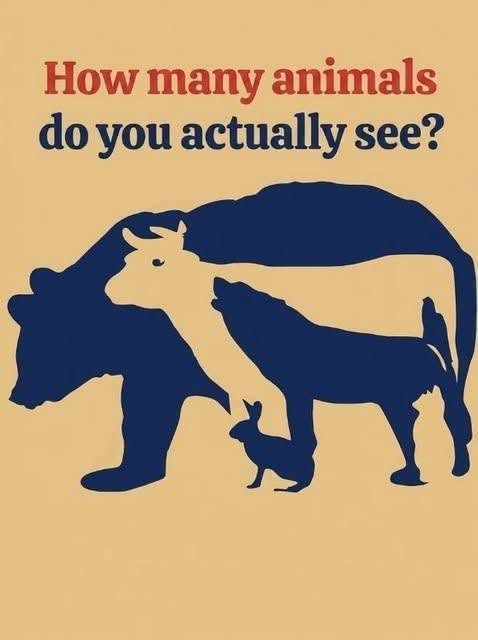
Optical illusion puzzles have a clever way of making us question our own eyes. At first glance, an animal picture may seem straightforward—you spot a few obvious figures and assume you’ve solved it.
Compare Pet Insurance
But look again.
Some shapes may be hiding inside larger outlines, while others appear only when you pay attention to the empty spaces between the objects. That’s what makes this type of visual brainteaser so entertaining: the answer isn’t always sitting directly in front of you.
The challenge is simple:
How many animals can you find hidden in the picture?
Don’t be too quick to answer. Take a moment to examine the entire image, including the spaces between the darker shapes.
Why This Puzzle Is Harder Than It Looks
Our brains are remarkably good at recognizing familiar patterns. When we see a large shape that clearly resembles an animal, we tend to identify it immediately and move on
That can actually work against us in an optical illusion.
Once your brain decides, “That’s a bear,” it may stop examining that part of the picture closely. Smaller shapes become easy to overlook because your brain has already created a meaningful interpretation of the scene.
This phenomenon is related to inattentional blindness, in which we can fail to notice something visible because our attention is focused elsewhere.
In other words, sometimes the problem isn’t that you can’t see the hidden animal.
It’s that your brain doesn’t consider it important enough to notice.
 The Animals You May Spot First
Several figures are designed to stand out more than others.
Compare Pet Insurance
-
- The Bear
The large dark figure is likely to grab your attention first.
- The Bear
Its size and recognizable outline make it one of the easiest animals to identify. Because it dominates part of the composition, your brain may naturally use it as an anchor for interpreting the rest of the image.
- The Cow
- The cow is another prominent figure that helps establish the main structure of the puzzle.
Solve Brainteaser Puzzles
Once you recognize it, you may feel as though you’ve already figured out the trick. That’s exactly when it’s worth slowing down and looking again.- The Mouse
The mouse is considerably smaller and can be much easier to miss.
After identifying the larger animals, deliberately scan the image for tiny outlines and shapes. Small figures can disappear surprisingly well when they’re surrounded by larger forms.
- The Mouse
-
- The Cat
Look toward the right-hand portion of the composition for the cat.
Its pointed ears and upright shape can make it recognizable once you’ve trained your attention on that area.
But finding the obvious figures may only be the beginning.
 Look at the Empty Spaces
Here’s where the puzzle becomes particularly interesting.Instead of asking only:
“What animals are drawn here?”
Compare Pet Insurance
ask yourself:“What animals are created by the spaces between the drawings?”
This technique is known as looking at negative space.
Negative space is simply the area surrounding or separating the main objects in an image. Artists and designers often use it intentionally to create hidden pictures, secondary shapes, or visual surprises.
In an optical illusion, the empty area can become just as important as the lines that surround it.
Why Negative Space Tricks the Brain
Your visual system is constantly trying to organize information into recognizable patterns.When you see several dark shapes against a lighter background, your brain tends to group those shapes into objects.
The lighter spaces may be treated as nothing more than background.
That’s where the illusion gets its power.
If you deliberately reverse your approach and study the background instead of the obvious figures, new shapes can suddenly appear.
Hire Math Tutors
You might find yourself thinking:“How did I not see that before?”
The Role of Pareidolia
Another interesting concept connected with visual puzzles is pareidolia.Pareidolia is the tendency to perceive a familiar image or pattern in something that may not actually depict that object—for example, seeing a face in a cloud or an animal-like shape in a shadow.
Optical puzzles can take advantage of this natural pattern-recognition ability.
Your brain is constantly asking, “What does this look like?”
The puzzle simply gives it multiple possible answers.
🕵️ A Better Way to Solve the Puzzle
If you’re still missing some of the animals, try this approach instead of staring at the picture randomly. - The Cat


